
When Confidence Is Not the Problem: A Systems View of Technical Burnout

Technical professionals often experience confidence issues as a personal weakness. We ask ourselves: Am I the problem? Am I not resilient enough? Should I just work harder?
But in many engineering and technology environments, reduced confidence is not simply a personal failure. It is often an emergent property of the system people are working inside.

When ownership is unclear, priorities contradict each other, decisions move without explanation, and communication flows through silos, even capable professionals can begin to doubt themselves. The issue is not always the engineer. Sometimes, the organisational engine is misaligned.
The personal toll of system dysfunction
In technical organisations, people often carry the emotional cost of broken workflows.
A missed handover becomes personal pressure. A delayed decision becomes self-doubt. A poorly defined interface becomes a late-night question: Why can’t I get this right?
This is especially common in engineering environments where individuals are expected to show resilience, technical ownership, and professional maturity, while also operating inside structures that make good performance difficult.
The transcript frames this clearly: engineers and technology professionals often struggle with confidence not because they lack capability, but because the system around them is full of confusion, friction, and frustration.
That distinction matters.
A technical professional still has responsibility. We still need competence, discipline, communication, and emotional resilience. But resilience alone cannot compensate forever for unclear ownership, moving success metrics, micromanagement, poor feedback loops, or contradictory priorities.
At some point, the system starts consuming the person.
Burnout as a system consequence
The burnout research often associated with Christina Maslach and Michael Leiter identifies several areas of work life that shape burnout risk: workload, control, reward, community, fairness, and values.
These areas are not abstract HR language. They are system variables.
If workload is consistently unrealistic, people compensate with longer hours. If control is low, people feel trapped. If fairness is inconsistent, trust breaks down. If values are violated, motivation becomes fragile. If community is weak, every issue becomes isolating. If reward is disconnected from contribution, effort starts to feel meaningless.

For engineers, this often shows up as a broken organisational engine. You are asked to deliver, but the requirements are unstable. You are expected to take ownership, but authority sits somewhere else. You are measured on output, but the dependencies are outside your control. You are told to communicate better, but the system has no reliable mechanism for shared visibility.
The result is not simply “stress”. It is systemic friction.
And when systemic friction continues long enough, individual resilience becomes the patch holding a broken mechanism together.
The self-doubt loop
One of the most dangerous patterns in technical organisations is the self-reinforcing loop between confusion and confidence.
It often works like this:
Confusion leads to reduced confidence. Reduced confidence leads to hesitation. Hesitation slows delivery. Slower delivery triggers more scrutiny. More scrutiny increases pressure and micromanagement. Micromanagement then creates even lower confidence and more confusion.

This loop is especially damaging because it can look like an individual performance problem from the outside.
A manager may see hesitation and conclude that the engineer lacks ownership. A team may see slow delivery and conclude that someone is not competent. A senior stakeholder may see rework and conclude that the team needs tighter control.
But tighter control may be exactly what makes the loop worse.
In systems terms, the organisation is treating the symptom as the root cause. Instead of asking, “Why is this person hesitant?”, the better question is:
What system conditions are making hesitation rational?
Maybe the decision criteria are unclear. Maybe previous mistakes were punished publicly. Maybe priorities change without traceability. Maybe the person has responsibility without authority. Maybe the communication channels reward silence until problems become urgent.
In that context, hesitation is not weakness. It is a survival mechanism.
Applying systems thinking
Systems thinking does not remove personal accountability. It places personal performance inside a wider operating model. Instead of asking only, “Who failed?”, we ask:
What feedback loops, incentives, interfaces, constraints, and decision structures produced this behaviour?
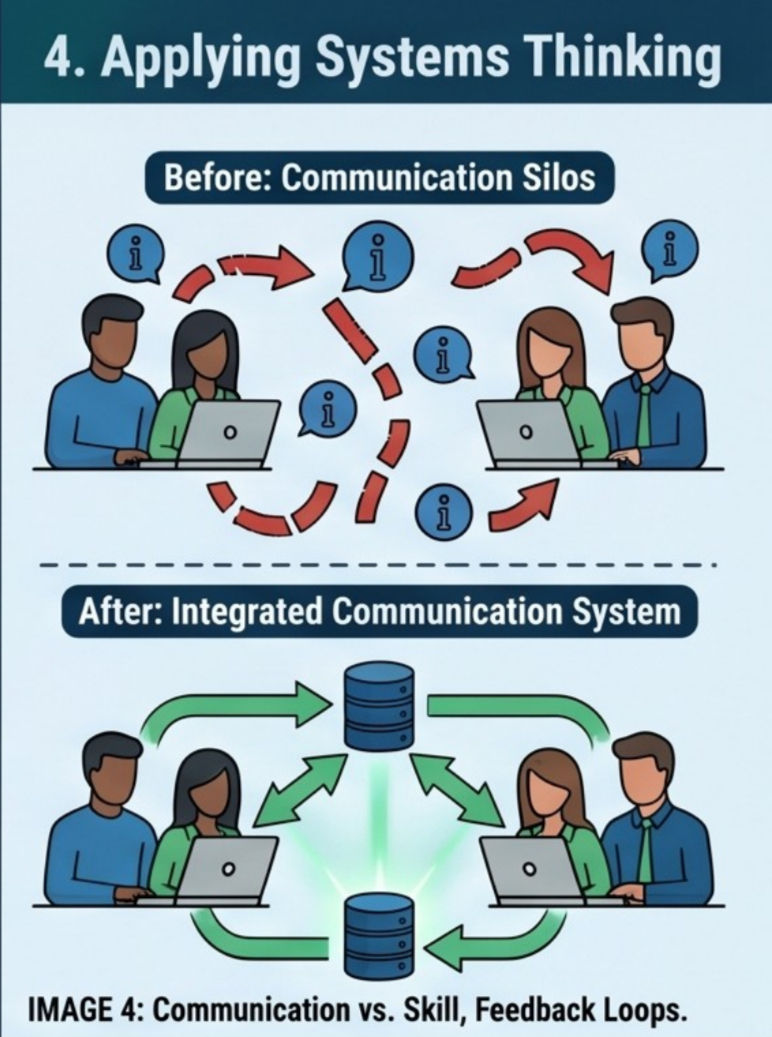
This is where technical organisations can learn from engineering itself. We would never debug a complex aircraft system by blaming one component without looking at interfaces, signals, loads, timing, failure modes, and operating context.
Yet in organisations, we often blame individuals before modelling the workflow. A healthier approach is to create integrated communication systems rather than communication silos.
That means clarifying ownership, making dependencies visible, documenting decisions, stabilising priorities, defining escalation paths, and creating feedback loops that help teams learn before failure becomes personal.
In practical terms, this can start with a few diagnostic questions:
What happens when a deadline is missed?
Do people immediately tense up and protect themselves, or does the team investigate the system constraint?
Are success metrics stable enough for teams to optimise around them?
Can engineers see how their work connects to upstream decisions and downstream users?
Is feedback captured in a way that improves the workflow, or does it disappear into meetings and private conversations?
Confidence emerges from a healthy system
The key insight is simple but powerful:
Confidence is an emergent property of a healthy system.
A capable person can move from one organisation to another and perform completely differently, not because their skills changed overnight, but because the system either amplifies or suppresses their contribution.
When the organisational gears are aligned, people gain clarity. With clarity comes better decisions. With better decisions comes faster delivery. With faster delivery comes trust. With trust comes confidence.
But when the gears are misaligned, even strong people begin to question themselves.
So the next time a technical professional seems hesitant, burned out, defensive, or low in confidence, it may be worth looking beyond the individual.
Maybe the person needs support.
Maybe the team needs better communication.
Maybe the system needs to be redesigned.
And in many technical environments, the honest answer is: all three.


Comments